Does Pet Insurance Cover Endoscopy?
Check endoscopy coverage by its clinical purpose, first-sign timeline and separate anesthesia, retrieval and pathology charges.
What matters on this page
Use these checkpoints to frame the literal question before reading the full guide.
Pet insurance may contribute to endoscopy when the underlying illness or injury and the associated expenses meet the policy’s terms. The word endoscopy alone does not establish coverage. Distinguish looking inside, taking tissue samples and retrieving a foreign object, then review each charged item against the pet’s history and applicable contract.
The sections below show how to verify the answer and what can change it.
Read eligible expenses alongside the reason for the scope
The reviewed Pets Best specimen, form IAIC-PB10001-ILL, section 1A provides a broad eligible-veterinary-expense framework subject to exclusions. Section 5A1 examines advice, treatment and related signs before coverage or during a waiting period. It does not supply a universal promise for every endoscopy. The applicable state form, schedule and actual records control the individual question.
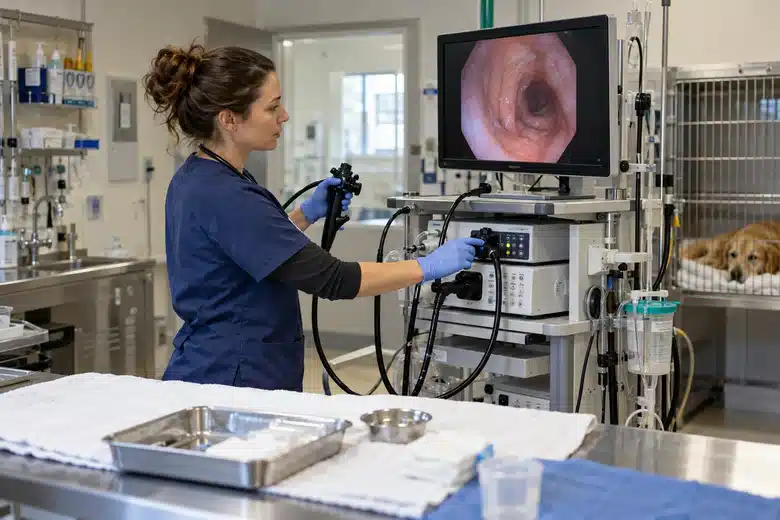
Cornell’s endoscopy brochure distinguishes visualization, tissue sampling and, in some cases, foreign-body removal. It also notes that capsule imaging cannot take tissue samples. Those clinical differences explain why an estimate may contain several services rather than one interchangeable “scope” charge.
Endoscopy invoice-to-policy review
| Invoice item | Indication/history | Relevant provision | Inclusion/exclusion evidence | Unresolved question |
|---|---|---|---|---|
| Endoscopic visualization | Symptoms and suspected cause | Diagnostics; eligible condition; timing | General specimen framework only | Is this investigation eligible even before a final diagnosis? |
| Foreign-body retrieval | Suspected object and incident history | Accident/illness definitions; exclusions | No individual incident decision | Is retrieval separately billed and is this event included? |
| Biopsy collection | Tissue needed during the procedure | Diagnostic sampling and eligible expenses | No selected-plan determination | Does the estimate include sample collection? |
| Pathology/laboratory analysis | Testing the collected material | Laboratory benefits and limits | Must be checked separately | Are lab fees and specialized tests eligible? |
| Anesthesia and monitoring | Technique and clinical plan | Associated treatment; exclusions | No automatic inclusion inferred | Which monitoring and recovery charges are itemized? |
| Consultation and medication | Referral, exam, discharge plan | Optional benefits and formulary | Specimen section2B distinguishes some options | Which options were actually purchased? |
Foreign-body retrieval
Biopsy collection
Pathology/laboratory analysis
Anesthesia and monitoring
Consultation and medication
The first sign can matter more than the appointment date
Build a chronology with the earliest relevant symptom, initial veterinary advice, policy effective date, any waiting-period end, referral and scheduled procedure. For example, an invented patient has recurrent vomiting before enrollment but an endoscopy booked later. The later procedure date does not by itself turn the earlier problem into a new covered illness. The insurer must assess the actual records and contract; do not rewrite the chronology around the appointment.
Records and referral packet
Ready to check current rates?
Keep policy terms, deductible, reimbursement and limits beside the quote so the comparison stays consistent.
Ask for a precise written answer
A useful question is: “Given these dates and this itemized estimate, which provisions determine eligibility for visualization, retrieval, biopsy, pathology and anesthesia, and what information remains needed?” Also ask whether a pre-treatment response is binding or provisional, whether referral or authorization is required and how a change in procedure would be handled. An administrative answer should not be mistaken for the veterinarian’s clinical decision.
Cornell describes anesthesia services as individualized for diagnostic and surgical procedures. Let the treating veterinary team decide the safe technique and urgency. Do not delay urgent assessment while resolving insurance administration.
A bounded coverage answer
No personal policy or state-specific enrollment packet has been reviewed for your pet. This analysis explains the coverage test and a documented specimen example; it cannot promise payment or specify a universal waiting period.
Common questions
Is pathology the same charge as the endoscopy?
Not necessarily. Sampling, laboratory analysis and the procedure may be separate estimate lines and should be checked individually.
Does removing a swallowed object guarantee an accident claim?
No. The definitions, incident facts, prior history and exclusions must still be applied.
Independent references
These links provide independent government, academic or reference background. Actual policy wording controls insurance eligibility, benefits and claims.
Ready to compare with clearer inputs?
Keep the policy terms beside the price, then continue to rates when the comparison is clear.